Platform Fluency Isn't Marketing Expertise: How Meta and Google Created a Generation of Fragile Marketers.
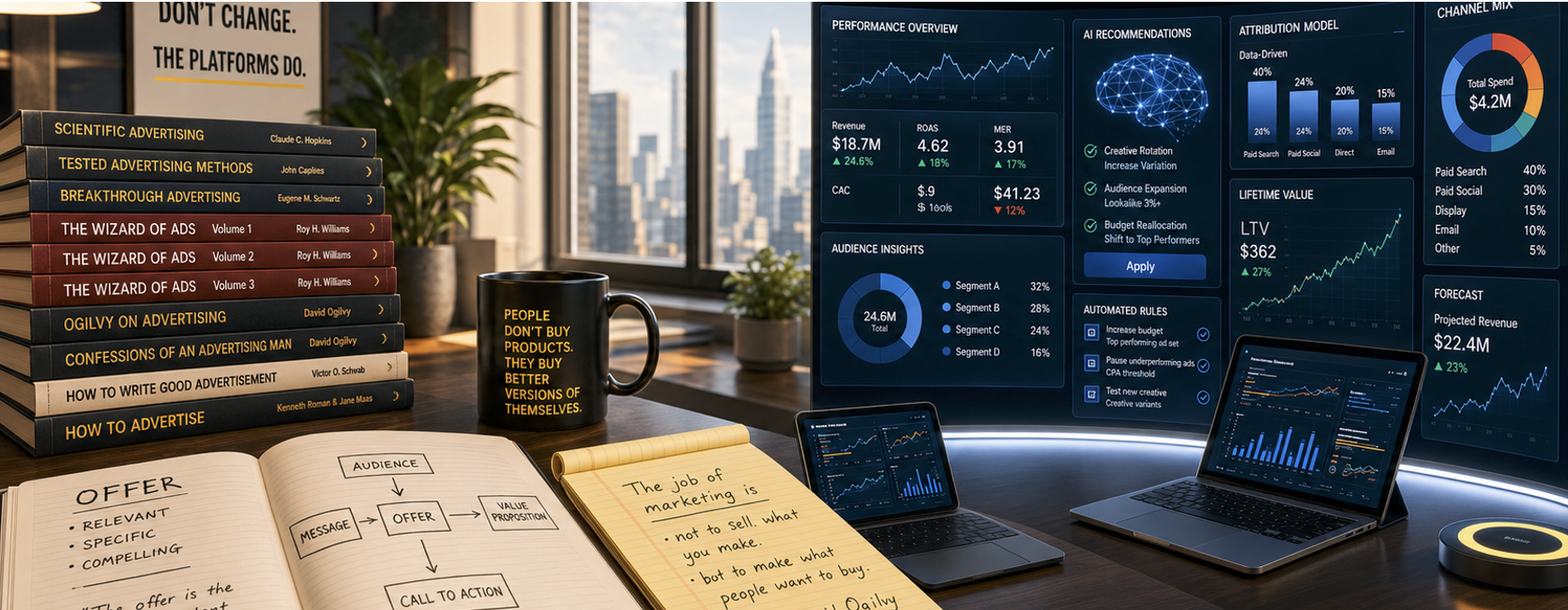
A few days ago, I was on a call with a founder, talking about hiring and agency partners. Somewhere in the conversation, he asked a question that's stuck with me since: “Why does it feel like so many people in marketing today don't really understand foundational marketing?” I’ll tease that out just a bit more, most only know a slice of the discipline, and that slice usually starts the day they personally entered the industry.
It's a sharp observation, and one that I've experienced firsthand, and unfortunately, it's becoming more and more frequent. Here's my take on why, and what to do about it if you're the client stuck working with a team that has the gap.
Marketing history didn't stop being useful; it just stopped being taught
When I started in marketing twenty-five years ago, if you wanted to get into marketing, you would learn about direct response first. And that was regardless of being consumer- or business-focused. You learned that every ad is a hypothesis, every offer has an elasticity, and every creative choice either moves a number or it doesn't. You learned this from mentors who'd traveled the road before you, testing their way to success. They not only learned from manual experience, but also by learning the old-fashioned way, from books. The feedback loop may have been slower, but it was brutally honest, you learned from failings and successes, and it forced a discipline that no shortcut could fake. Then the shortcut arrived.
When paid social and programmatic search emerged, you could suddenly "do marketing" by logging into Meta Ads Manager or Google Ads - actually, it's advertising, but you get the point - and the platform itself would practically tell you what to do next. An entire generation of marketers got trained not by mentors steeped in Ogilvy, Caples, Wunderman, and Schwartz, but by the platform's own dashboard. The platform became the curriculum. It's an excellent curriculum for running the platform, and a terrible one for understanding why an offer works, how audience psychology drives response, or what actually moves lifetime value.
That's the "learning begins now, looking forward" phenomenon. Someone who started their career in 2019 optimizing ROAS in a Facebook Ads dashboard has genuine, real skill, but it's skill built entirely on top of a foundation they never had to build or learn themselves, because the platform built it for them. When the platform changes (iOS 14.5, cookie deprecation, CPMs spiking), that skill doesn't transfer, because it was never rooted in the underlying principles in the first place. It was rooted in the interface.
Why this matters more than it seems
This isn't nostalgia for the "good old days." It's a practical problem. Fundamentals are what let you adapt when the tools change, like with Meta's Andromeda update. Someone who understands messaging structure, offer configuration, audience segmentation, and the mechanics of a value proposition & call to action can walk into any channel - TikTok, retail media, email, television - and figure out how to make it work, because they understand what actually drives a person to buy, not just which button to click in which ad platform.
Someone who only knows the interface is helpless the moment the interface changes. And interfaces change constantly. That's precisely what happened to a wave of "performance marketers" after the privacy changes hit, years of channel-specific tactical knowledge, and almost no transferable strategic instinct underneath it.

It also explains a symptom a lot of operators and founders notice but can't quite name: an agency or in-house team that's very fluent in reporting dashboards and platform jargon, but strangely unable to answer basic questions like "why will this audience respond to this offer" or "what's our actual customer acquisition math, fully loaded." That's not a competence problem in the traditional sense, it's a foundations problem. They were never taught to ask those questions because the platform never asked them either.
What to do if you're stuck with this kind of agency partner or employee
If you're a founder or executive and you suspect your agency or internal team has this gap, here's how to diagnose it and what to do next.
Test for fundamentals, not fluency
Platform fluency is table stakes and easy to fake with a confident tone. Ask questions that require principles first: "Walk me through why you think this offer will convert with this audience." "What's our real payback period once you include returns and discounts?" "If this channel disappeared tomorrow, what would you do?" A team with real fundamentals will have an answer rooted in the customer and the economics. A team without them will drift back to platform language, "the algorithm favors," "we're optimizing for," "the pixel needs more data."
Insist on a written hypothesis before every test
This is the single best forcing function I know. Before any major campaign, creative, or offer test launches, require a one-paragraph hypothesis: what we believe, why we believe it, how we are going to measure results, and what result would prove or disprove it. Teams that understand fundamentals do this instinctively. Teams that don't will resist it, because it exposes that they're running tactics, not testing ideas or building strategy.
Bring finance into the room early

This is where my own background, CFO before CMO, has helped shape how I think about this. A marketer with fundamentals thinks in unit economics automatically: contribution margin, payback period, LTV, CAC, blended vs. incremental CAC. If your agency can't have that conversation fluently, or treats it as "not their job," that's a signal. Marketing without a finance lens is just spend; marketing with one is an investment thesis you can actually defend to a board, investors, or private equity.
Look for people who can explain the "why" behind the classics
You don't need someone who's read every old direct-response book cover to cover. You need someone who can explain, in their own words, why a strong offer beats strong creative, why urgency and scarcity work psychologically, why a bad audience kills a good ad. If they can explain the why, they have the foundation. If they can only describe what's working right now, they don't.
Don't confuse tenure with fundamentals
Someone with 15 years in the industry can still have started their real education the day self-serve platforms took over, and someone three years in can have been mentored properly and have the fundamentals cold. Years of experience and years of foundational training are not the same currency, evaluate for the latter specifically.
The uncomfortable truth is that the platforms made it easy to look competent without ever being taught the underlying discipline. The fix isn't complicated, but it does require asking different questions than most clients are used to asking, and being willing to walk away from a partner who can't answer them.

About the Author
Kent Mora is a Chief Marketing Officer and former Chief Financial Officer with more than 25 years of marketing experience helping companies accelerate profitable growth. His uncommon blend of marketing, finance, and operations enables him to evaluate opportunities the way founders, boards, and investors do - not just marketers. He specializes in building scalable growth engines through performance marketing, AI, and data-driven decision-making for brands navigating rapid growth, transformation, or private equity investment.